
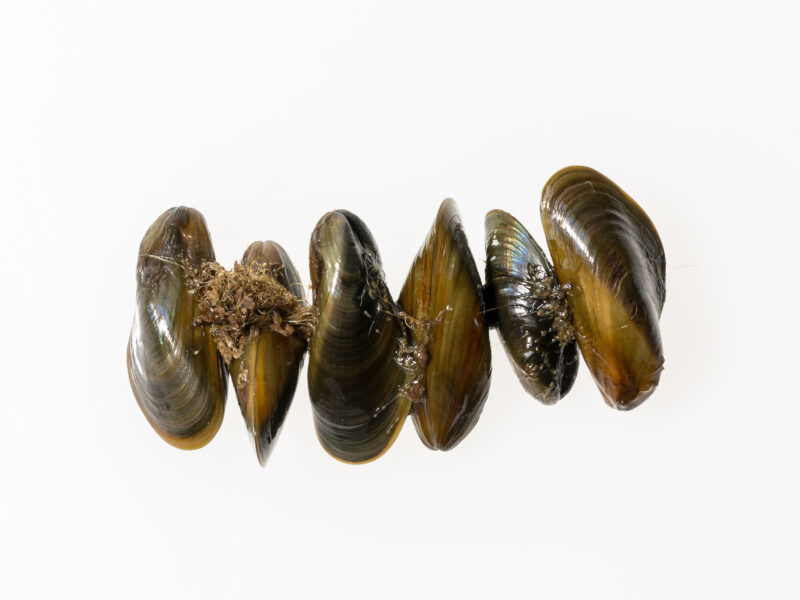
Less than two years ago, a freshwater mussel that nobody in North America had dealt with before showed up in California’s water system. It spread rapidly. Since its arrival, utilities, hydroelectric operators, industrial water users, and dam owners have been watching it the way you’d watch a fire moving toward a property line. California’s experience is the best data anyone has right now, and it’s worth learning from before the same thing happens somewhere else.
What Are Golden Mussels?
Golden mussels, Limnoperna fortunei, are small freshwater bivalves native to rivers and lakes in China and Southeast Asia. They spread through Asia and South America over the last several decades and became one of the most damaging aquatic invasive species anywhere they landed. In October 2024, they appeared in North America for the first time , in California’s Sacramento-San Joaquin Delta.
These mussels attach to hard surfaces with byssal threads, the same mechanism zebra and quagga mussels use. That lets them colonize intake structures, pipelines, screens, pumps, valves, almost anything submerged. Their larvae are microscopic and drift with the current for weeks before settling, so an infestation can take hold throughout a connected water system long before anyone sees an adult mussel. Once a colony establishes, it restricts flow, fouls equipment, and drives up maintenance costs.
How Is This Different From Zebra and Quagga Mussels?
Golden mussels behave a lot like the species most operators already know. Same rapid reproduction, same attachment mechanism, same fouling risk. What’s different is their tolerance. They handle lower calcium, warmer water, lower dissolved oxygen, and a wider range of pH and salinity. A water system written off as unsuitable for zebra or quagga mussels may still be suitable for golden mussels. If your facility was cleared years ago under those old assumptions of mussel behavior, that clearance doesn’t automatically carry over.
The Sacramento-San Joaquin Delta feeds one of the largest interconnected freshwater systems in the country. Drinking water, irrigation, hydropower, and industrial supply are all tied together through the State Water Project and Central Valley Project. Once golden mussels got into that network, they had access to thousands of miles of canals and aqueducts. Within a year, they’d reached facilities hundreds of miles from where they were first found.
Because the larvae are invisible, an infestation can take hold before anyone notices. Reduced flow through intakes and pipelines. Fouled screens and strainers. Weaker cooling performance. Pumps and valves that stop working the way they used to. More maintenance, more energy use, and a real chance of an unplanned outage.
Once a reproducing population establishes in a connected watershed, eradication is off the table. From there, everything is about managing the infestation, not preventing it. Three things help: reassess your risk against golden mussel tolerances specifically, not an old zebra or quagga rating; start monitoring so you have warning before infrastructure fouls; and build a response plan now, with defined treatment thresholds, instead of deciding under pressure later.
ASI Marine has spent close to 40 years helping utilities, hydroelectric facilities, industrial water users, and dam owners manage invasive mussel risk through vulnerability assessments, monitoring, treatment planning, and long-term strategy.
No two facilities run the same program. California proved just how quickly a golden mussel infestation can take hold. The best time to find out where you stand was before golden mussels arrived. The next best time is no
Where does your facility stand on exposure and preparedness?
A 3-minute assessment ASI uses to scope water infrastructure across the West. Your water source sets your exposure; your plan and monitoring set your preparedness. The two are shown separately, on purpose, so one doesn't distort the other.
Takes about 3 minutes · Your results are shown immediately
Almost there. Let's match you with the right next step.
Your exposure and preparedness profile is ready. Tell us what would help most, and where to send it.
Where should we send your results?
| Prepared Now | Reactive Later | |
|---|---|---|
| Timing | Before confirmed presence | After mussels are established |
| What's involved | Risk assessment completed, a plan in place, a monitoring routine | Intake, pipe, treatment retrofits, flow issues, potential shutdowns |
| Typical driver | Scheduled upgrade | Emergency response |
| Who's involved | Your team, on your timeline | Contractors, regulators, emergency budget approval |
We will contact you about your request.
A specialist will follow up using the details you provided. You've also been emailed a copy of this summary.
Recent Comments